Peer Review Resource Hub

Peer review isn’t just an academic exercise, but rather an essential skill for students’ professional development and future careers. By practicing peer review, students learn to give and receive constructive feedback – skills vital in both college and the workplace. By offering peer review practice opportunities in class, you support students in their learning and growth as writers.
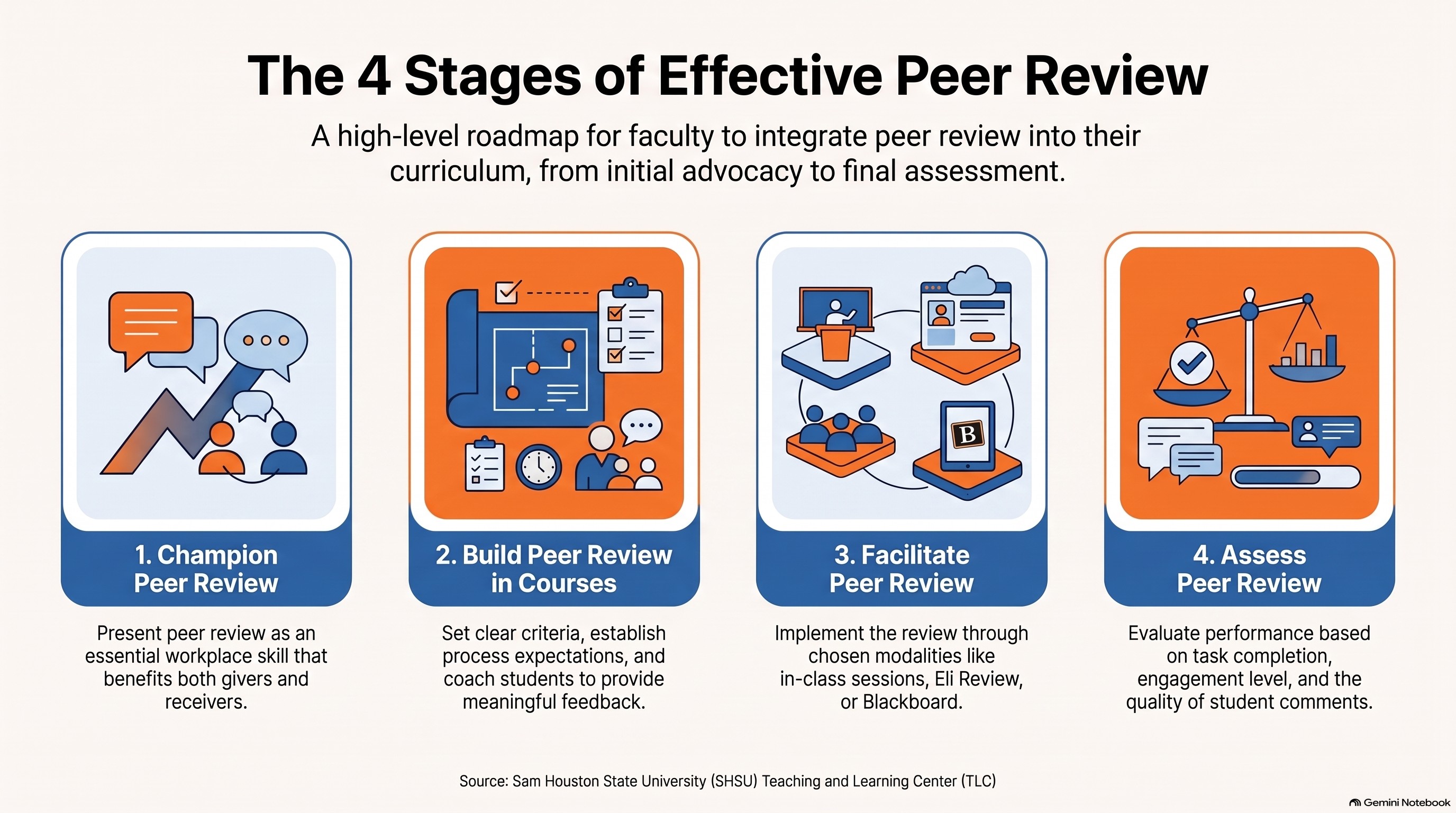
The Peer Review Process Explained
The process begins with introducing peer review, planning for it in your classes, facilitation, and finally assessing its implementation.
The reasons for advocating peer review in your classes help students in both their college and professional careers by:
- Strengthening your students’ ability to recognize strengths and weaknesses in their own and others’ writing;
- Improving their ability to give, receive, and constructively use feedback;
- Using feedback and self-evaluation of their writing to re-envision and strengthen work; and
- Developing their writing, critical thinking, and interpersonal communication skills.
Through writing, feedback and revision assignments across courses, we provide students the opportunity to practice what workplace professionals do on a daily basis:
- give and receive feedback to/from colleagues,
- integrate the most helpful feedback and build on it, and
- revise to strengthen writing.
1. Set Expectations
- Discuss with students the importance of peer review in college and the workplace.
- Highlight that the purpose of peer review is to help them communicate more effectively.
2. Set Process & Criteria
- Determine the peer review process.
- For example, will students trade papers? Use online software? How many papers will each student review? How much in-class and out-of-class time will you dedicate?
- Set the evaluation criteria students will use in reviewing each other’s writing.
- Link the criteria to the learning objectives for the assignment.
- You can set the criteria and/or engage your students in the process of setting the criteria.
3. Coach Students to provide Meaning Feedback comments to their Peers
- Emphasize that meaningful peer review goes far beyond “good job” and is much more in-depth than proofreading for grammar and mechanics.
- Model characteristics of helpful commenting, with samples.
- Provide prompts to help students develop meaningful comments.
4. Coach Students to Use Feedback Wisely
- Practice selecting the most helpful feedback.
- Model ways to build the feedback into an active revision plan.
- Emphasize that using feedback is about strengthening the communication, not just “checking a box” to respond to a comment(s).
For a downloadable form, please choose this link: Building Peer Review into your Courses
When it comes to designing peer review for your course, there are many forms peer review can take! You will want to consider your course modality, your students’ learning needs, and availability of technology when deciding how you want to implement peer review in your class.
It is important to determine ways to assess learners’ performance and ask them to reflect on their learning.
Peer review can be assessed in multiple ways, so students can numerically understand the goals of each task translated into a grade.
Below are a series of suggestions for you to incorporate into your peer review assessment practices. Some of the categories that can be evaluated throughout peer review practices include: 1) Task Completion and Engagement and 2) Quality of Writing Production (some of the items can be applied in multiple categories).
Task Completion and Engagement
-
- Task Completion on Time
- Task Completion
- Word count in each essay
- Comment Ratio
- Comments Given
- Comments Received
- Comment Ratings (given and received)
- Comment Endorsement
- Suggestion Applicability (on corrections)
Quality of Production
-
- Types of words included in each essay
- Quality of textual argumentation
- Inclusion of elements learned in class
- Textual structuring (introduction, body, conclusion)
- Incorporation of proper citation and reference styles (APA, MLA, Chicago, Harvard)
- Quality of comments
Please see an example of a grade calculation here.
About the Work Group
These resources were developed by the SHSU Work Team on Effective Peer Review Practices. Our team is grateful to have received a Teaching Innovation Grant (TIG) for 2023-2024, sponsored through The Teaching & Learning Center, to support the development of these resources.
Jamile Forcelini, Ph.D.; Associate Professor of Spanish, Department of World Languages and Cultures; College of Humanities and Social Sciences
Kendall Gragert, Ed.D.; Associate Director, Elliott T. Bowers Honors College
Renée Gravois, Ph.D.; Associate Professor of Marketing; Department of Management, Marketing, and Information Systems; College of Busines Administration
Carroll Ferguson Nardone, Ph.D.; Professor of Technical Communication, Department of English; College of Humanities and Social Sciences
Cynthia Zinakova Cooper, MBA, The Teaching & Learning Center, Graduate student, Communication Studies
Contact the TLC
Visit Us
The Teaching & Learning Center, 1901 Avenue I, The College of Humanities & Social Sciences (CHSS) Building, Suite C002, Huntsville, TX 77340
Mailing: The Teaching & Learning Center, Box 2390, Huntsville, TX 77341-2390