Dietetics
Become a collaborative health partner who works with patients to create custom-tailored programs that improve health and wellbeing.
- Master of Science
- Huntsville
- Face to Face
36 Credit Hours
A Patient-Centered Degree
Accreditation
The SHSU Combined MS/DI Program is accredited by the Accreditation Council for Education in Nutrition and Dietetics (ACEND) of the Academy of Nutrition and Dietetics; 120 South Riverside Plaza, Suite 2190; Chicago, IL 60606-6995; 1-800-877-1600 x5400. www.eatrightpro.org/resources/acend
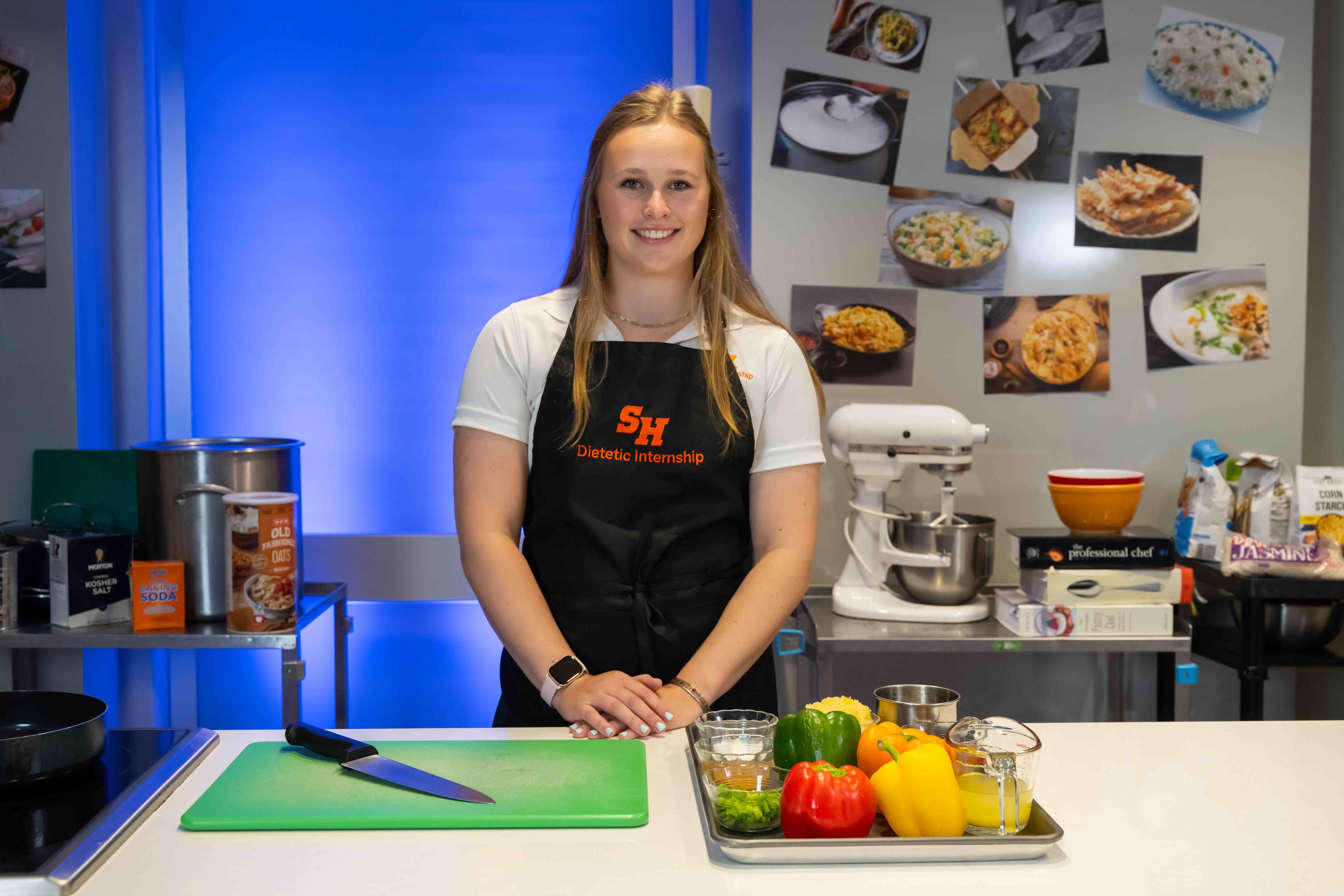
Become an RDN. The Master of Science in Dietetics Internship (MSDI) at Sam Houston State University is designed for individuals pursuing the Registered Dietitian Nutritionist (RDN) credential. This advanced, ACEND-accredited program combines rigorous graduate coursework with 1,000+ hours of supervised practice in clinical, community, and food service settings.
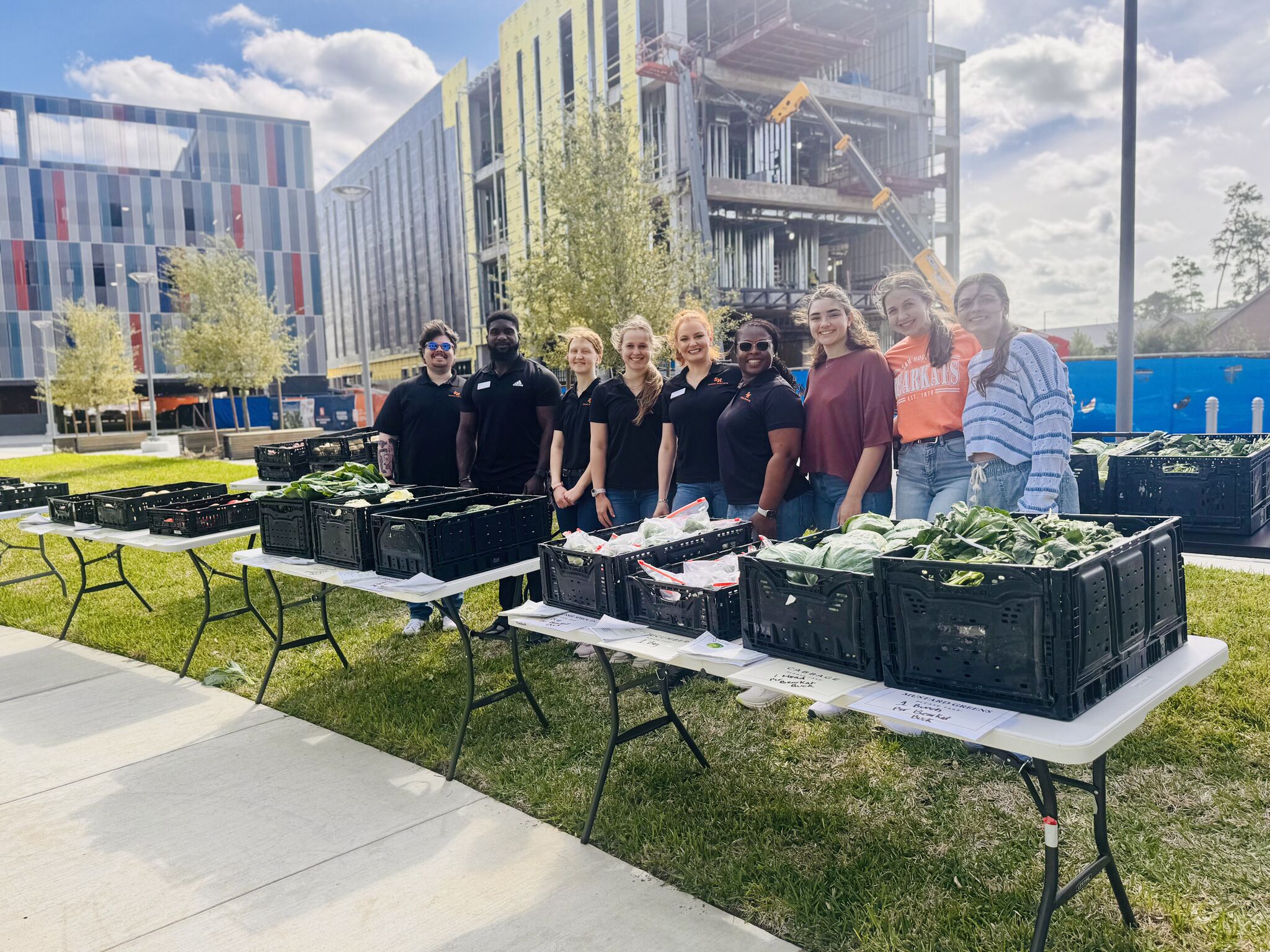
With a strong emphasis on community wellness, research, and public health, students engage in projects that make a real impact—like improving food access through SHSU’s Farmers Market Initiative and the SHSU Food Pantry, or leading nutrition outreach and education in underserved communities.
application deadlines
Fall
- November 1 — Priority Deadline
- August 1 — Final Deadline
A Career for the Future
Each year, we learn more and more about how diet and other factors affect our health. Earning your Master of Science in Dietetics at Sam Houston State means you’ll blend classroom skills with real-world practicums to become a collaborative health partner who can help patients achieve their health goals.
-
A Built-In Internship
Sam Houston State University’s Master of Science in Dietetics requires a 1,000-hour internship that gives you real-world experience. Those hours are divided into professionalization seminars and deeper study of clinical nutrition, community nutrition and food service systems management. You will work toward your hours on-site at medical centers, community hospitals, community health agencies, or public school food service facilities.
-
An Affordable Degree
The Master of Science in Dietetics at Sam Houston State University is designed to be completed in one year. That means it’s affordable, from both a budget and time-management standpoint. Make an investment in your future without compromising your present.
-
A Complete Degree Path
Your path to earning a Master of Science in Dietetics blends classroom work with real-world experiences. This blended approach means you’ll be a well-rounded graduate, with the knowledge and expertise to excel in this ever-changing field.
Dietetics Details
Information on the SHSU Dietetic Internship mission, goals, objectives, and outcomes, including eligibility, admissions, program completion requirements, and DPD student resources.
The mission of the Combined Master of Science in Dietetics and Dietetic Internship Program at Sam Houston State University is to prepare graduate students for evidence-based entry-level dietetics practice to demonstrate knowledge, skills, and values necessary to enhance the health, wellness, and quality of life of individuals in the community, the nation, and the world.
Program Goal #1: To prepare graduates who are competent to practice as entry-level dietitians upon program completion.
- Objective 1: At least 80% of interns complete program requirements within 26 months (150% of planned program length). (RE 3.3.b.1)
- Objective 2: Of graduates who seek employment, at least 70% percent are employed in nutrition and dietetics or related fields within 12 months of graduation.
- Objective 3: At least 90% percent of program graduates take the CDR credentialing exam for dietitian nutritionists within 12 months of program completion.
- Objective 4: The program’s one-year pass rate (graduates who pass the registration exam within one year of first attempt) on the CDR credentialing exam for dietitian nutritionists is at least 80%.
Program Goal #2: Program graduates will demonstrate an evidence-based approach to their practice to enhance the health, wellness, and quality of life of individuals in the community, the nation, and the world.
- Objective 1: On the Employer Survey, at least 90% of employers will indicate that program graduates can work through nutrition-related problems and ideas using critical thinking by rating their satisfaction level with a 3.0 - satisfactory or 4.0 - more than satisfactory.
- Objective 2: During the first year of employment, at least 80% of employed graduates will rate themselves as 3.0 - prepared or 4.0 - well prepared for their first dietetics-related position.
- Objective 3: At least 80% of MS/DI program graduates will respond with a 3.0 – they agree or 4.0 - they strongly agree that they used evidence-based nutrition to improve the health and wellness of individuals.
- Objective 4: On the Employer Survey, at least 90% of employers will indicate that MS/DI program graduates are prepared for entry-level employment during their first year by rating their satisfaction level with a 3.0 - satisfactory or 4.0 - more than satisfactory.
Program outcomes data is available on request.
Educational and Professional Requirements to become a Registered Dietitian Nutritionist include:
- Completion of a minimum of a bachelor’s degree at a U.S. regionally accredited university or college and course work accredited by the Accreditation Council for Education in Nutrition and Dietetics (ACEND) of the Academy of Nutrition and Dietetics.
- Receipt of a verification statement from such an accredited program.
- Completion of an ACEND-accredited supervised practice program consisting of a minimum of 1000 hours of supervised practice.
- Passage of a national examination administered by the Commission on Dietetic Registration (CDR). For more information regarding the examination, refer to CDR’s website at www.cdrnet.org.
SHSU’s Combined MS/DI program assists qualified students with completion of step 3. Upon successful completion of the program, graduates will receive a verification statement indicating eligibility to sit for the Registration Examination for Dietitians administered by the CDR.
For more information on becoming a Registered Dietitian Nutritionist (RDN), go here
State Certification or Licensure
After successful completion of the RDN exam, graduates may apply for licensure in Texas and other states that require licensure of dietitians. Additional information on licensure of dietitians is available here
Admission Requirements
All applicants must meet the following criteria to be considered for program admission:
- GPA Requirement: Overall GPA of 3.0 or GPA of 3.0 or greater within the last 60 hours of academic work.
- GRE Requirement: The GRE requirement will be WAIVED if the applicant graduated with a cumulative GPA of 3.0 or higher. However, if the applicant has a cumulative GPA less than 3.0, the GRE will be required with a minimum score of 290.
- Verification Statement or Declaration of Intent to Complete Degree from an ACEND-accredited Didactic Program in Dietetics (DPD). Students who have completed the DPD five or more years prior to the internship start date are required to update their core knowledge with at least two additional upper-level dietetics courses prior to potential admission to the program. Courses must be completed through an ACEND-accredited nutrition and dietetics program. One course must be in the subject area of Medical Nutrition Therapy. The student should contact the program director to discuss additional coursework.
- Completion of a baccalaureate degree from an accredited college or university.
Dietetic Internship Application Instructions
Important Application dates:
- October 1st, 2024, for Priority Applications in DICAS open
- November 1st, 2024, is the Priority DICAS Application deadline
- January 20th, 2025, is the Regular DICAS Application deadline
- All applicants will be notified on or before March 1st, 2025
- All applicants are required to accept or decline their acceptance on or before March 15th, 2025.
Students applying for the MSDI Program are required to submit their application through DICAS (https://portal.dicas.org). The prospective student applicant is responsible for any fees associated with DICAS.
Step 1: Submit your completed application through the online centralized internship application DICAS, here
Application through the online centralized internship application, DICAS must include:
- Personal Statement
- Three recommendation letters must be from 1) a dietetic academic professor, 2) a work or volunteer supervisor, and 3) a final reference of the applicant’s choice.
- The fees to applicants for using DICAS will be $50
Step 2: The Program Director will contact you to schedule an interview
Step 3: Students accepted into the MSDI program will be required to complete a SHSU Graduate Application, /dept/graduate-admissions/
Application Review
Applications of qualified candidates will be reviewed by a selection committee and scored on GPA, GRE score, personal statement, recommendation letters, work & volunteer experience, awards, scholarship, and service (in that order).
Interviews: Applicants will be required to complete a virtual interview.
Anticipated Dietetic Internship Costs
The total cost of the dietetic internship is variable, but the following are expected expenses and fees with their anticipated cost.
During Application Process
- DICAS application fee - $50 for first application
- SHSU DI application fee - $50 (non-refundable)
Prior to the Program Start Date
- Background Check - $100
- Physical Exam – varies; $20 - $150
- Vaccinations – varies; $30 - $200
- CPR Certification - $35
- ServSafe Manager Certification - $125 (online course), $36 (online exam voucher)
- HIPAA Training - $30
- Medical Terminology Course (if not completed a course or equivalent work) - $90
Insurance (must have coverage for entire program)
- Health Insurance – varies; $20 - $150 per month
- Auto Insurance – varies; $30 - $80 per month
- Liability Insurance - provided by the University
Membership Fees
- Student membership to the Academy of Nutrition and Dietetics - $58 per year
- Membership in state or local organization(s) – varies; $0 and up
Living Expenses
- Meals – varies; $100 - $350 per month
- Transportation - varies; $100 - $150 per month; a reliable vehicle is required to travel to rotation sites within two hours of Huntsville
- Housing - varies depending on location; $420 - $800 per month
Program Uniform
- Black foodservice shoes - $50 - $100
Dietetic Internship Fee - $300
RDN Review Course - $500
Professional Meetings/Conferences - varies; $250 and up
Additional Costs – Rotations in Houston
- Tolls & Downtown Houston parking – varies; $60 - $130
- Students may purchase an EZ Tag or choose to use the Park & Ride
Anticipated Graduate School Expenses
Expected graduate school expenses for a graduate student completing the 36-hour Master of Science in Dietetics degree are as follows:
- Graduate application fee - $50 (non-refundable)
- Tuition and Fees
- Texas Resident ~$16,800
- Non-Resident ~$20,500
- Textbooks – $250 to $300 per semester
- SHSU Parking Permit - $75 (Zone 3)
- Application for degree - $40
Financial Aid: Students enrolled in this program are eligible for financial aid. For more information, visit the Financial Aid website at www.shsu.edu/dept/financial-aid/index.html
Scholarships: Students may apply for outside scholarships on an individual basis. The Texas Academy of Nutrition and Dietetics and the Academy of Nutrition and Dietetics have scholarships for members. For more information, please visit Scholarships - Texas Academy of Nutrition and Dietetics
SHSU Scholarships available to graduate students:
Scholarships4Kats
Assistantships: Graduate, research, and/or teaching assistantships may be available to selected students who have been accepted into the program. Financial support includes a stipend.
The MS/DI program is 36 credit hours, completed over 4 semesters.
First Fall Semester (9 credit hours)
- DIET 5079 Dietetic Internship Practicum
- HUSC 5330 Seminar in Human Sciences Research
- DIET 5396 Cultural Food Counseling
Spring Semester (9 credit hours)
- DIET 5079 Dietetic Internship Practicum
- SOCI 5314 Social Statistics
- DIET 5395 Dietary Supplements
Summer Semester (9 credit hours)
- DIET 5367 The Consumer and Food Technology
- HUSC 5375 Seminar in Recent Developments in Family and Consumer Sciences
- DIET 5385 Sports Nutrition
Second Fall Semester (9 credit hours)
- DIET 5079 Dietetic Internship Practicum
- DIET 5383 Research Problems
- DIET 5398 Public Health Nutrition
*Transfer of Credit: The maximum number of hours that may be transferred into the MS/DI program is 9 hours. Students are encouraged to contact the Graduate Director concerning transfer credit.
Graduates will receive a verification statement indicating eligibility to sit for the Registration Examination for Dietitians after achieving the following:
Completion of the M.S. in Dietetics degree which includes:
- passage of a comprehensive exam
- completion of all course work
- minimum overall GPA 3.0
Completion of the Dietetic Internship program which includes:
- completion of a minimum of 1000 hours of supervised rotation experiences
- completion of all rotation evaluations and forms, including rotation hours log, conditions and populations weekly log, and end-of-rotation evaluations
- receive a final rating of 4 (proficient) or 5 (exceptional) on each learning activity used to evaluate competencies
- pass each rotation of the supervised practice experience
- completion of a digital DI Practice Journal
- completion of a two-day or longer on-site RDN examination review course (fulfilling this requirement does not guarantee passage of the Registration Examination for Dietitians)
- attendance of all seminars, workshops, meetings, and conferences as required by the Dietetic Internship Director
- passage of an exit examination (mock RDN exam) at a level of 80% or higher
- completion of a program exit survey
- maximum amount of time allowed for program completion is 25 months
Benefits of Being a Preceptor
- Recruitment. You have the advantage of reviewing the graduates performance and screening them for a match as future employees. Since the graduate is already familiar with the facility, they require less orientation and training upon hire.
- Provide assistance with job responsibilities and additional duties. For example, graduates can be asked to develop nutrition educational materials, analyze menus, teach classes, or work on projects that staff might not have the extra time to complete.
- Contribute to the profession. You will serve as a mentor and role model to help qualified graduates complete their education.
- Personal satisfaction experienced by staff of mentoring graduates.
How to be a Preceptor or Mentor
Go to: https://www.eatrightpro.org/acend/training-and-volunteer-opportunities/preceptors-and-mentors
Interested in being a preceptor for SHSU’s MS/DI program? Do you have 24 hours per week to work with a dietetic intern? Are you a RDN in a clinical, community, or food service management area? If you answered yes and you want to learn more about becoming an SHSU MS/DI preceptor, contact the Dietetic Internship Director at tdl030@shsu.edu.
Free Online Preceptor Training
The Commission on Dietetic Registration offers a free Online Dietetic Preceptor Training Module worth 8 CPEUs.

Find Your Future Career
With a Master of Science in Dietetics, you can work in school or universities, hospitals, private practice, community health and other non-profit organizations, or chart your path as an entrepreneur.
Faculty Invested in You
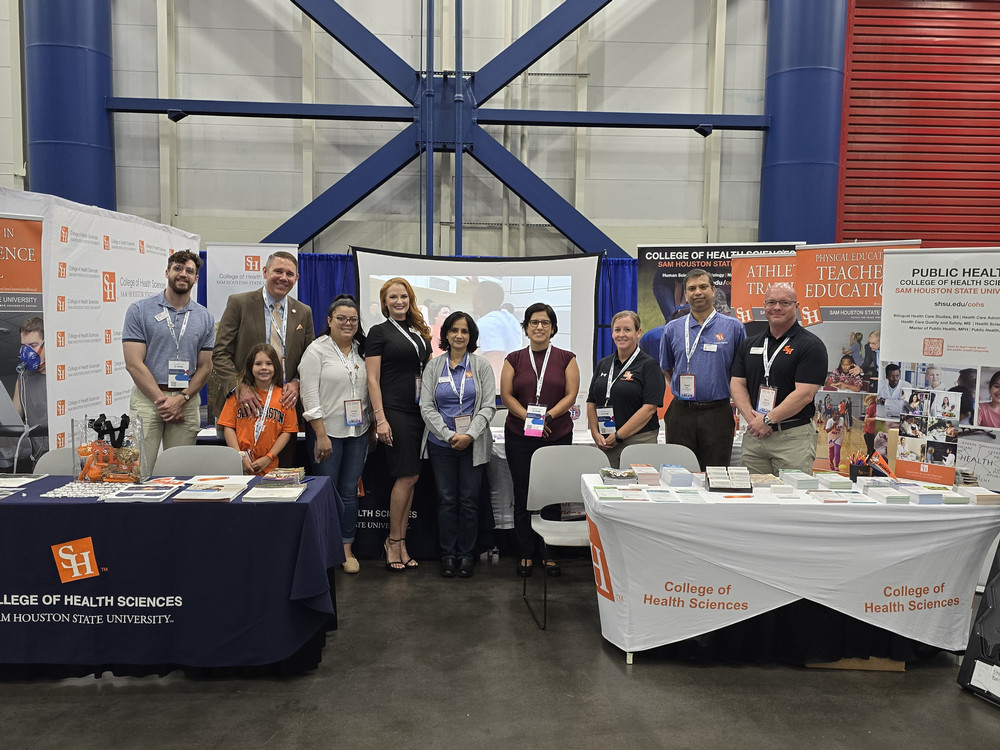
Sam Houston State University faculty bring a wealth of experience to the classroom. The professors who will guide you through your Master of Science in Dietetics are supportive, collaborative and dedicated to your success.
Dietetic Internship Director
Dr. Tabbetha Lopez, R.D., L.D.
936.294.4164
tdl030@shsu.edu
Become a Bearkat
Ready to learn how SHSU can help you or to start your application today? Our team is here to help. Call 936-339-0148