SHSU Student Develops Software Tool for Law Enforcement Analysts to Combat Dark Networks
SHSU Student Develops Software Tool for Law Enforcement Analysts to Combat Dark Networks
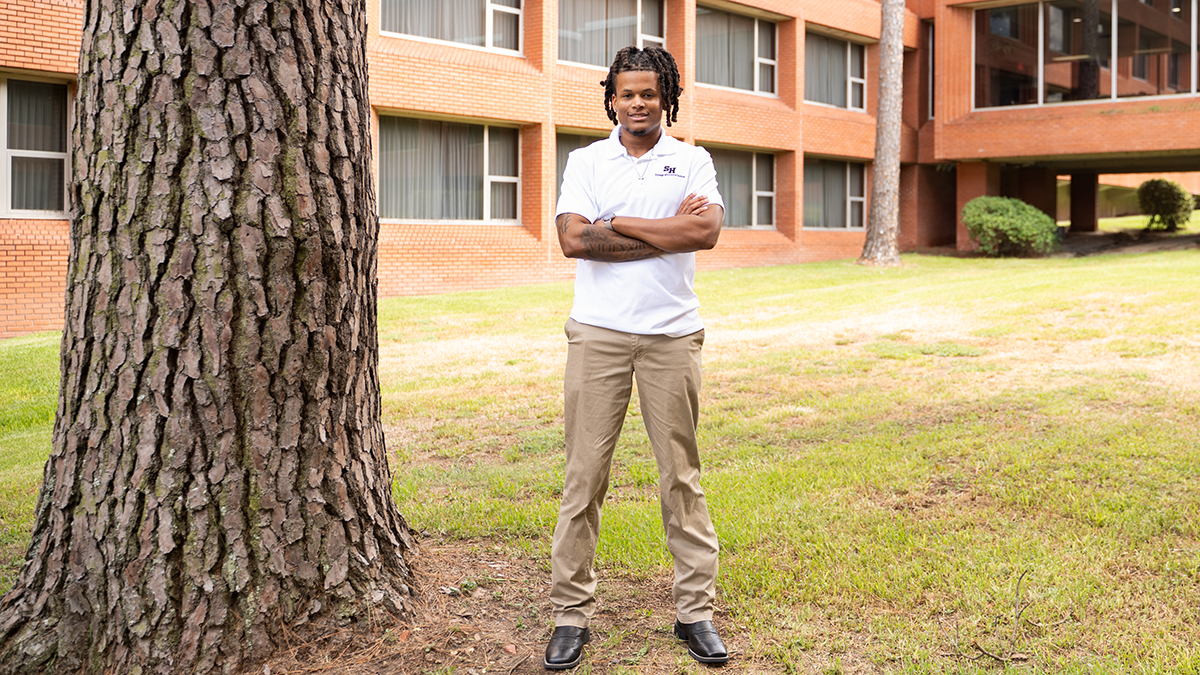
Braell Dotson, a computer science student at Sam Houston State University’s College of Science and Engineering Technology (SHSU-COSET), developed a new centralization plugin for Gephi, an open-source software program utilized by organizations such as the Institute for Homeland Security, the Bill Blackwood Law Enforcement Institute of Texas and the Center of Intelligence and Crime Analysis.
“Nate Jones came to me with the idea. The plug-in seemed like a great opportunity to learn, so I thought I should take on the challenge,” said Dotson. “It also was a chance to solve a problem, which is always worth doing.”
Commonly referred to as the “Photoshop for graph data,” Gephi allows users to feed in large amounts of data and then interact with it through visualizations, manipulating structures, shapes and colors to reveal hidden patterns. However, the software lacks centralization metrics, which are some of the most crucial measures in social network analysis for examining dark networks. Named after SHSU’s beloved mascot, the Bearkat Centralization plugin addresses this gap by outputting eight centralization metrics in a single, clean report, providing an easy-to-use resource for training, instruction and practice.
“Does it make sense to target central figures of a terrorist network if it is a decentralized network? No, that would be a waste of resources,” said Nathan Jones, security studies professor and chair. “But if it is a highly centralized network, targeting central actors could be highly disruptive. Having these metrics available now in a plugin in the top open-source platform for law enforcement will improve their ability to fight crime and terror networks and efficiently use resources.”
During the plugin’s development, Jones guided and mentored Dotson, while also teaching him about network analysis. For Dotson, this was his first opportunity to collaborate directly with a faculty member on software development.
“It was amazing working with Jones,” Dotson said. “He was very patient with the challenges we faced, and he taught me a lot about network analysis. It was great having him in my corner during the process because he was very motivating.”
While Bearkat Centralization awaits formal approval from Gephi, the function is already gaining attention from faculty at other institutions. Oscar Contreras-Velasco, an assistant professor in the Department of Sociology at the University of California, Davis, tested the feature before its launch.
"The plugin worked great. It was very informative to show some of the basic centrality measures of the networks I work with,” said Contreras-Velasco. “I appreciated how easy it was to use. Highly recommend."
Another evaluator, Sean Everton, a professor in the Defense Analysis Department and the director of the Common Operational Research Environment Lab at the Naval Postgraduate School, looks forward to incorporating the plugin in his network analysis courses.
“Gephi is a widely used and powerful network analysis tool. Curiously, though, up until now it has not included a function to calculate the degree to which a network is centralized,” said Everton. “The Bearkat Centralization plugin for Gephi fills this need. I’ll be using it in my network analysis classes. I’m confident that I won’t be alone.”
With this project closing and graduation on the horizon, Dotson looks forward to starting a career in software development or cybersecurity. In the meantime, he continues to apply the skills and knowledge gained from this experience to personal projects.
“I am already working on developing my own mobile app, which I’m very excited about,” said Dotson. “This project has created a lot of networking opportunities for me. It has also allowed me to better prepare for certain real-world issues that might come with releasing an actual project.”
Recognizing his impressive achievement in completing this undertaking, Dotson received the SHSU Coin for Excellence and Innovation, presented by retired Maj. Gen. David Glaser, the university’s chief strategy officer.
This page is maintained by SHSU's Communications Office:
-
Director of Content Communications: Emily Binetti
-
Communications Manager: Mikah Boyd