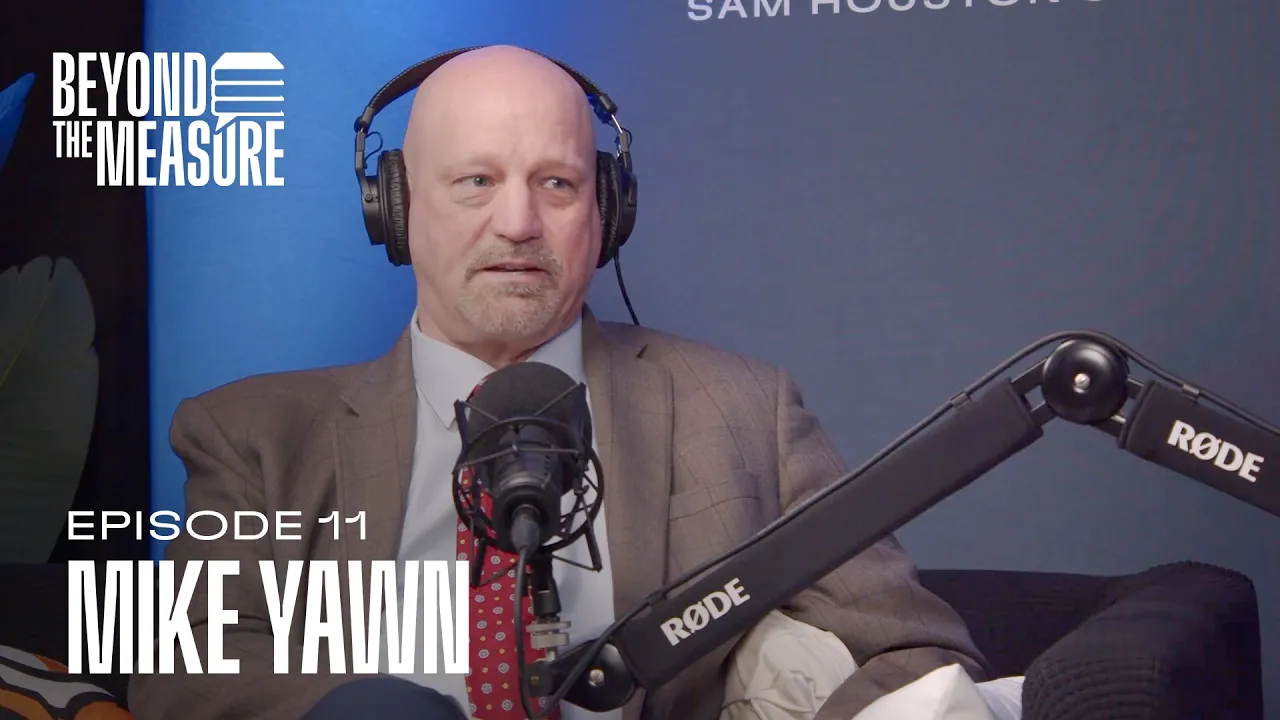
Beyond The Measure Episode 11: Mike Yawn

Beyond The Measure Episode 11: Mike Yawn
At Sam Houston State University, students can connect what they're learning in their courses to real-world impact by engaging with the Center for Law, Engagement and Politics (LEAP). Mike Yawn, director of the LEAP Center, joined our hosts to discuss how students from any degree path can drive change through civic engagement, and how he and the LEAP Center facilitate opportunities for students to get involved through internships and more. The following lays out the discussion in a convenient Q&A format. For the full Beyond the Measure experience, watch the full episode below or on YouTube.
Can you explain what the LEAP Center is and the role it plays here at Sam Houston State University?
It's a little bit difficult to explain because it's not a program that exists at every university. In fact, it's probably unique in the United States. And so, it's not something that people can fit into their conceptual lenses. We oversee a number of things, but LEAP stands for Law, Engagement, and Politics. But the engagement is what we really emphasize, and that's what takes us to a myriad of activities and locations. So, we do advising. We advise about 700 students a year. We take students on educational field trips. We've taken them to more than 100 museums. I also teach classes typically relating to law. We also have a speaker series. So we take them to various speakers and bring speakers to campus. Then we do numerous volunteer activities and we also oversee three different internship programs for the university.
When students given get involved with LEAP, what are they stepping into beyond just another campus organization?
If they want to actually attend one of our events, it can be a one-off thing. And we hope that they are enjoying that. So, next week, for example, we're going to Texas A&M. We'll visit the Bush Presidential Library, and we'll see that for two hours. Then we have an appointment with the graduate recruiter, and they will learn about MBA programs and then we will go to an author speaker series and then we will have dinner and return back to Sam. So that one event is something that any student can do, but they're not committing to something larger. They're not joining something. They have an opportunity to see something maybe they've never seen before: a presidential library or a presidential speaker, chief of staff. Now, it is a nine-hour day, so that is what they're stepping into that day, but if they never want to do another event with us, that's fine. We have about 2,000 students each year who participate at that level.
In your time of being here, what do you think young people are searching for right now when it comes to leadership and engagement?
I think one of the real benefits of Sam Houston is that there are so many different models of leadership and engagement that they can pick and choose what fits them, but also explore things that they may not have known existed. We have generations that differ with the environment in which they grow up in and it was different for me and it was different as you have just pointed out different for you because you are in a different generation but there is a real paucity of students having the ability to interact with others. Everything is so much more phone- and digitally oriented. What I hope LEAP tries to provide is an opportunity to gain those soft skills; to get back into shaking hands, looking people in the eye, meeting important people, so that when they go out and take leadership positions themselves, they've already been trained on how to interact with people like they hope to be.
How do you help students connect with their learning in the classroom to real-world responsibilities?
We do this in a number of ways, but we follow a model that was proposed by John Dewey, and that has been sort of elaborated by many others, but it's experiential learning. And we follow a three-step process where students prepare for what they're going to experience. They experience it and then they reflect on it. So we're not just out doing stuff. Not that there's anything wrong with just going out and experiencing things, but we actually want them to do what your question suggests, which is tie together what the theories are in the classroom with what actually happens in the real world. So, before we go see a speaker, whether it's a president of the United States or a mid-level government bureaucrat, the students will do a little bit of research on that person so they know what they're getting into, have good questions prepared, know what they should be asking and then they experience it. Lastly, the students run our social media accounts, which includes a blog, and last year they did 200 stories on their blog. So, this is a three-part process of priming or preparing, experiencing and then reflecting on that experience. And that should bring together what the classroom is, what the real world is, how those overlap and how they can differ as well.
From your perspective, why is it important for students regardless of majors to understand how communities and institutions function?
One of the first things we try to teach them is all the different moving parts in a community because if they want to get anything done, even at Sam Houston, I mean, when you try to work with any within any sort of bureaucracy, sometimes you hit roadblocks. So knowing the personalities behind them, being able to break down those silos, which I think is what you guys are doing right now, by bringing together different departments to speak directly to the university, allows people to get things done with people they might not be accustomed to working with. So, if a student goes into a community that may be in the South, they need to know city hall, the mayor, the county judge, the church leaders and the newspaper or radio stations, the nonprofit leaders and the largest employers. It's not just something they're learning about Walker County; that is true of every county in the United States and if they can understand that system, they can take that system with them to their own communities and become leaders in those communities.
What changes do you see in students from the time that they first walk into your classroom or into LEAP to the time that they graduate?
We recently celebrated our 20th anniversary of the LEAP Center and so many of the students were coming back and explaining those stories. One student, we took her during her freshman year to the governor's inauguration and that involved spending the weekend in Austin, Texas. We try to take as many students as we can fit into one or two vehicles, but the goal is to lay the groundwork for them to learn more about how Austin works and possibly become Austin interns. So two years later, she actually applies for the Austin internship, gets the highest ranking from the interview committee and Governor Abbott hires her. So in 2023, she is attending a governor's inauguration and two years later, she's working for the governor.
You've touched on this a little bit, but can you talk a little bit more about some of the trips and engagement opportunities that students participate in?
Instead of typically going to a conference in New York City, where things are enormously expensive, we will find a midsize city where students can still learn quite a bit, but it will allow us to take students to the conference and then we tie that around different learning opportunities. For example, if the conference is in, say, Jackson, Mississippi, we're going to learn about civil rights and music. Then, we will drive to save money further, but also so we can stop along the way in New Orleans to see where Homer Plessy caught his bus that led to the Plessy v. Ferguson case. Or we'll go through Tupelo, Mississippi, to see Elvis Presley's birthplace, then we'll go to Vicksburg, Mississippi to see the Vicksburg battlefield. This way, they are able to see how all these things fit together and how experiences in one area can affect experiences in another area. So, we've done that throughout the years, and I think we have taken students to more than 100 museums, 29 states, 11 national parks and maybe 26 state capitals.
How does LEAP influence the culture of engagement on campus?
We do not, for example, count any volunteer hours. We're not trying to amass hours. When somebody asks us if we can help with something, we don't think about the hours except to say, do we have the resources to do it? What is the mission? Does our mission in LEAP, which is to provide unique educational opportunities to the students and to make a difference in the community, overlap with whichever organization is reaching out to us? Then, we see what resources are required to do this event, and if we have the resources and it's a good cause, then we do it. If that's 15 hours, then it's 15 hours. If it's two hours, it's two hours. We're not interested in how many hours there are; we're not trying to reach a total; we want to accomplish the mission. The best example of this is that, since 2008, we have worked with different agencies both locally and in the Harris County area to help people earn their citizenship. When we were asked to help with that, we wanted to know how long it would take to get people from where they are with the knowledge to where they need to be to pass the naturalization exam. We came up with that being about 15 hours. It's about three or four hours of teaching a week for five weeks, but our goal is to help people get their citizenship. So, we've worked with about 500 immigrants over the last 18 years from 28 different countries, and about 325 of them have earned their citizenship.
When students leave Sam and they go on into their big person job, what do you hope that they carry with them into their careers and into their communities?
Well, I think a lot of the things that they carry with them are things that their parents have taught them. And I think that is something that has been impressive about Sam Houston State University. Not all of the students that we have come in with amazing ACT scores or SAT scores or a great deal of cultural knowledge. Some haven't had much travel experience, but they come from, oftentimes, very tight families. Their families have taught them things about integrity, character, doing the right thing and hard work, and I think that Sam has been able to enrich that experience with educational opportunities, which, combined with character, creates the formula for leadership. I think they go out in the world now armed with leadership, and I've seen a lot of leaders emerge and it's really wonderful. Our students are definitely special.
We talk a lot about the students, their processes and what LEAP means to them, but what has leading and building LEAP meant to you personally?
It's helped me so much because I learn from my students. I have tried my whole life to learn Spanish and I fail at it miserably. I don't have one of the plastic brains that can learn foreign languages, but for whatever reason, a large number of Hispanic students are drawn to the LEAP experience. When we travel, they will bring lotería cards with them. So,there was this one time in 2017/2018 when I knew something like 57 words of Spanish. I knew all of these words, and even though I wasn't able to master the language, it helped me understand their culture. It also helped me understand how hard it can be for young people to learn things that they have no interaction or experience with, because here I am failing at something that I have no interaction or experience with. So I think the wonderful thing about being in education is constantly being a student yourself and having this lifelong learning attitude that allows you to look at things in the same way that young people look at new experiences as well.
So looking forward, what are you excited about for the future of the program?
LEAP has never led an international trip and that's something that I would enjoy doing. I have had former students who have led me on international trips to Mexico to different parts of their hometown and to some national parks.
One thing that we also try to do is, every four years we try to go to presidential inaugurations. So we have been sort of to every presidential inauguration since 2005. The most interesting one was President Obama's inauguration because they were expecting 500,000 people and 2 million people showed up. And the most challenging were the last two. So in 2021, instead of truly doing an inauguration trip, we did a civil rights trip in honor of Kala Harris being the first African-American female vice president. But then, in 2025, we got to DC but the temperature was 18° or something and they brought it inside. We were not included on that list and therefore we watched it from the Potomac River on a computer outside of D.C., but we still had that experience. We started it off in Philadelphia, where American democracy was born and ended up in DC where the 47th president was being inaugurated. So, I'd like to actually get back there before I get too old to do this and actually get to see another inauguration with the students again. It's something everybody should experience once. I've experienced it many times, but I will be doing it with new eyes because the students will be experiencing it for the first time.
So, if a student was listening right now and they were wondering whether they were ready or not to step into something like this, what would you tell them?
We try to start slowly because it can be overwhelming. We do about 150 events a year. So, I try to pick two or three things that might be of interest to that particular individual. I often begin by advising a student, asking what they want aside from classroom learning to enrich their education. There are 250 organizations on campus; there's something for everybody and then they can see if some of the LEAP activities are for them. But we would try to start off with something that would be interesting to them; then, if they like it, they can experience more things and eventually do as many things as they want. But we do have some requirements: students have to put some skin in the game. So if we go on a trip, they have to pay for part of it. It's always an affordable park, but they have to show that this is meaningful to them and that they are willing to put skin in the game for their own education. We can't ask other people to invest in their education if they won't invest in their education. That investment also comes with good grades, so, the better grades, the more opportunities that we can provide them. We also explain to them what being professional and representing the university means. So when we do events, they need to wear a suit. If they don't have a suit, we work with them to go to Tripod's Closet, and they can get something that will look professional. That way, we're now working on something together rather than it being a handout that we provide to students.
This page is maintained by SHSU's Communications Office:
-
Director of Content Communications: Emily Binetti
-
Communications Manager: Mikah Boyd