Full Circle at Camp Strake: Dr. Norman E. Vinn Visits SHSU-COM

Full Circle at Camp Strake: Dr. Norman E. Vinn Visits SHSU-COM
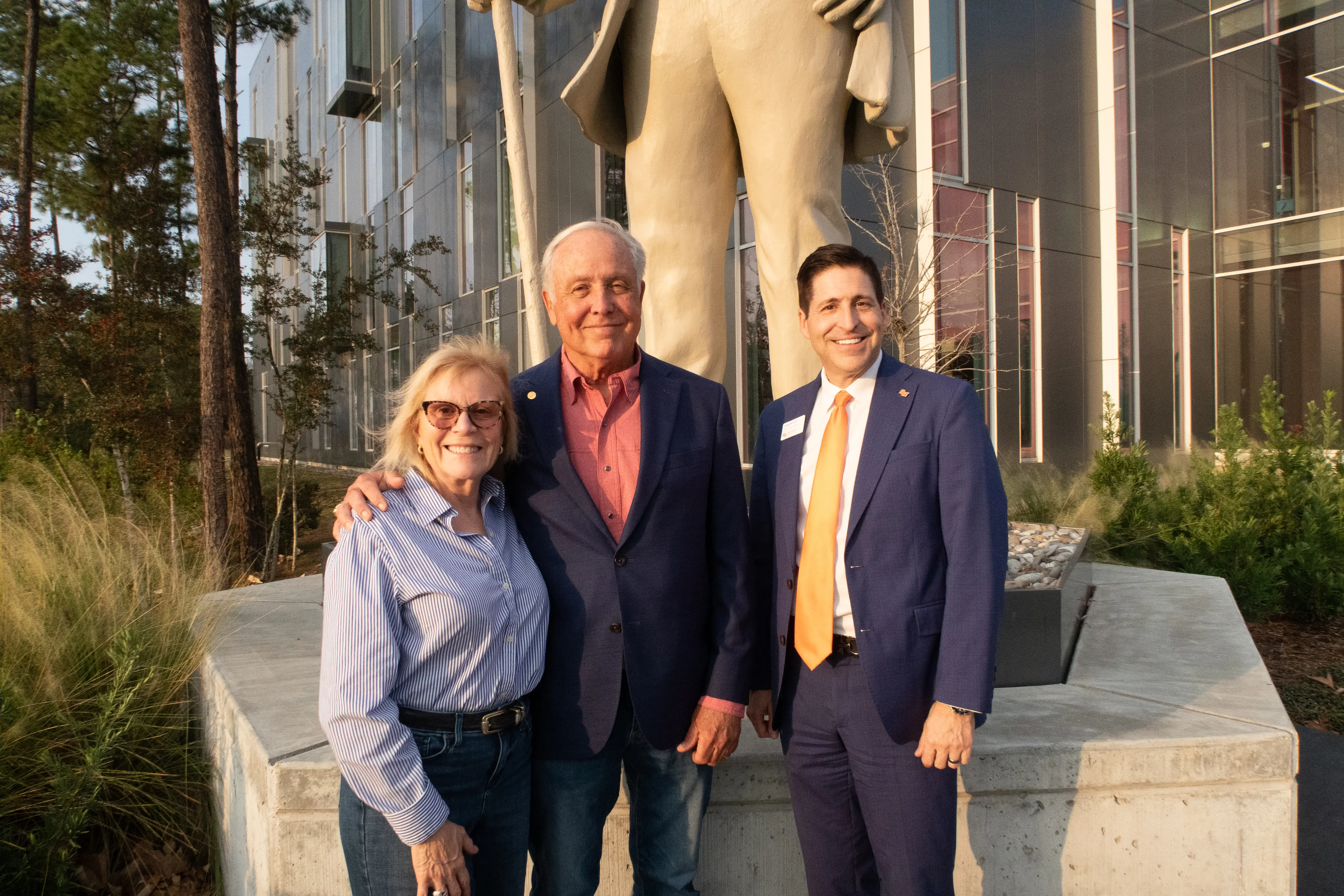
When Norman E. Vinn, DO, stepped onto the campus of Sam Houston State University College of Osteopathic Medicine, the visit carried a quiet sense of return.
Long before SHSU-COM existed, the land was Camp Strake, a Boy Scout camp surrounded by dense forest and centered around a lake. Dr. Vinn remembers coming to Camp Strake as a teenager through the Boy Scouts, when trips there were a major outing for his group based in Houston Heights. He recalls arriving late on Friday nights, setting up camp in the dark, and spending full weekends immersed in outdoor routines that fostered independence, teamwork and resilience.
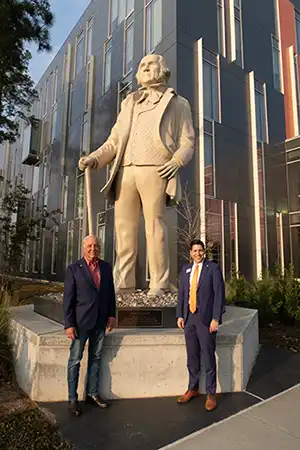
Seeing that same land now home to a medical school training future physicians is both unexpected and meaningful. For Dr. Vinn, the transformation represents a full circle moment. It was not planned, but rather a fortunate convergence. The idea that an osteopathic medical school now occupies ground that once shaped early lessons in community and discipline feels fitting and represents another point of pride for osteopathic medicine in Texas.
His wife, Marsha Vinn, was also with him during the visit and jokingly suggested that one or two Camp Strake stories were enough for the day.
Some of his strongest memories come from a demanding Boy Scout program known as aquatic school, where participants trained extensively in swimming, canoeing, and rowing. Dr. Vinn has described the experience as physically and mentally challenging. He did not pass the program the first time, returned the following year better prepared, and succeeded. He credits that experience with reinforcing discipline, perseverance and the value of sustained effort.
That combination of challenge, accountability, and persistence would later surface as a throughline in his career.
Over the decades, Dr. Vinn has built a national reputation as both a clinician and a leader within the osteopathic profession. He served as president of the American Osteopathic Association in 2013 and remains active in national leadership today. He currently serves on the board of the American Osteopathic Information Association, where his focus includes health information systems, emerging technologies and medical artificial intelligence.
At the heart of that work is a consistent commitment to service. Dr. Vinn has long advocated for care models that meet patients where they are, particularly those who are homebound or face barriers to access. His work helping advance modern home-based care, often described through the concept of the “Residentialist,” emerged from observing how easily patients can fall through the cracks when timely care is unavailable.
Underlying both his clinical work and leadership philosophy is a simple principle.
“It’s important to be a servant leader,” Dr. Vinn said. “Don’t ask people to do things you wouldn’t do yourself.”
He said leadership is essential in today’s healthcare environment, where physicians navigate complex systems beyond the exam room. He believes physicians must be prepared to advocate for patients and the profession to protect meaningful clinical relationships.
That same approach shapes Dr. Vinn’s thinking about the future of healthcare technology. As medical artificial intelligence becomes more common in clinical settings, he believes osteopathic physicians must be actively involved in shaping how these tools are developed and applied.
Osteopathic medicine’s biopsychosocial, whole-patient approach, he argues, should be reflected in the data, logic, and recommendations produced by AI systems.
Equally important is maintaining appropriate guardrails.
“The quality of an AI response depends on the quality of the prompt,” he said. “If you don’t have the right foundational knowledge, you won’t recognize a hallucination when it shows up.”
For medical education, that means teaching students how to evaluate, question and verify AI-generated information rather than accept it at face value. Without strong foundational knowledge, clinicians may not recognize when AI outputs are incomplete or inaccurate. Human judgment, he emphasizes, remains essential.
As SHSU-COM takes early steps toward developing a medical artificial intelligence institute, Dr. Vinn believes medical education must focus on teaching students how to critically evaluate and verify AI-generated information. Preventing the use of AI is neither realistic nor productive. Instead, future physicians must learn how to engage with these tools responsibly and apply human judgment to every clinical decision.
When asked why colleagues often describe him as someone who sees where healthcare is headed, Dr. Vinn points not to prediction, but to creativity.
“Creativity is seeing connections between things that aren’t obvious,” he said.
That mindset has guided his ability to connect patient care, education, leadership, and technology across decades of change. Standing on land that once shaped his early sense of discipline and community, now dedicated to training physicians to serve Texas communities and engage thoughtfully with emerging technology, that mindset feels especially fitting.
For Dr. Vinn, progress and purpose are not competing ideas. They are strongest when they grow from the same ground, shaped by service, judgment, and the responsibility to think beyond what is immediately visible.
This page is maintained by COM Communications:
-
SHSU-COM Director of Marketing, PR & Communications: Brittany Foreman