Where Movement Meets Medicine: A Cross-College Collaboration Supporting Student Growth
Where Movement Meets Medicine: A Cross-College Collaboration Supporting Student Growth
For dancers, every leap, lift and landing depends on the body. It is the instrument that makes their art possible, and protecting it is essential to sustaining a career in the arts.
That shared understanding is shaping a collaborative learning experience between the graduate dance program in the College of Arts and Media and the College of Osteopathic Medicine at Sam Houston State University (SHSU-COM).
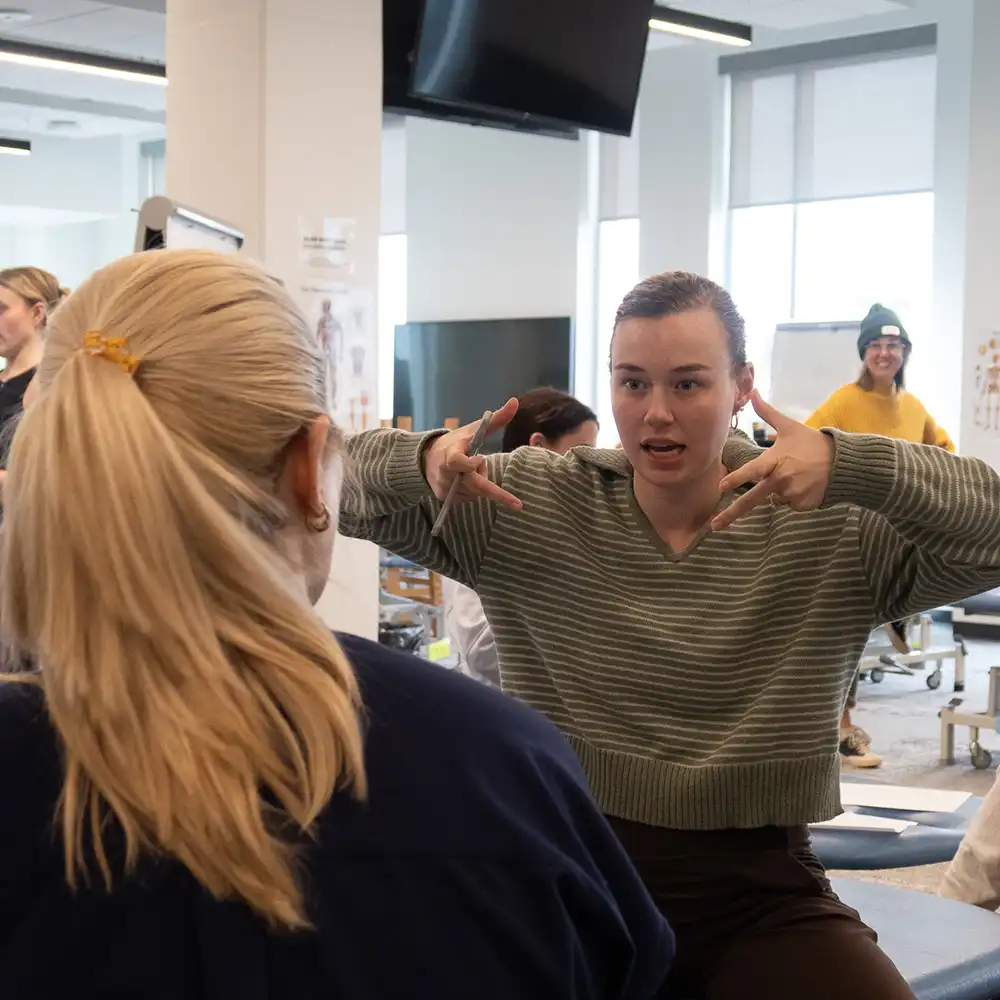
Adele Nickel, assistant professor of dance, is leading a graduate course centered on somatic approaches to movement. Rather than teaching steps solely from the outside in, the course challenges dancers to develop deeper internal awareness of how movement feels. The aim is to connect sensation, alignment and expression in ways that support both performance and longevity.
“My hope is that they begin to think of themselves as humans who happen to dance and want healthy, functional bodies for a long time, rather than dancers who carry a body around and beat it up all the time,” Nickel said.
Because dancers rely on their bodies daily, sustainability is central to the curriculum. This semester, that focus expanded beyond the studio.
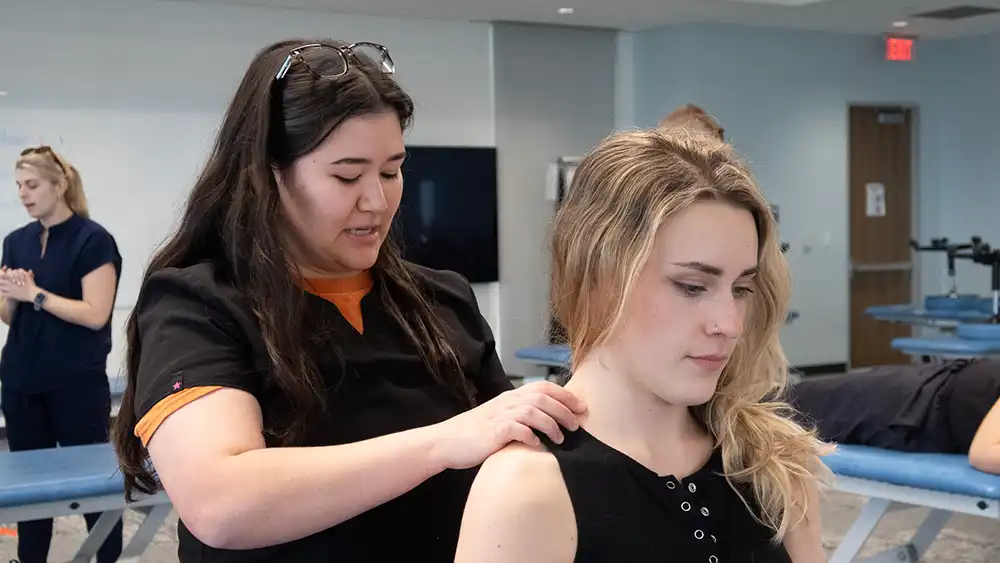
Each week, graduate dance students travel from Huntsville to the Conroe campus to receive osteopathic manipulative treatment, or OMT, from student doctors under the supervision of Juanita Brown, DO, osteopathic faculty member at SHSU-COM. OMT is a hands-on approach used to assess mobility, relieve strain and support the body’s natural ability to heal. For dancers who place repeated demands on joints, muscles and connective tissue, preventive care can be as important as treatment after injury.
“The graduate students have been surprised by how much the student doctors can perceive from just a short assessment and by how holistic the approach to treatment is,” Nickel said.
The sessions serve as both treatment and training. Those working toward their MFA in dance receive individualized care tailored to the demands of performance. Student doctors gain experience working with a population that requires precise attention to alignment, balance and repetitive strain.
“As dancers, a lot of the time we’re told to suppress the pain. You can still kind of dance, you can still kind of do things,” said Mary Kuhn, a third-year MFA student in dance. “Having the full-body assessment made me realize there were more issues than I would have thought otherwise.”
For Kuhn and her peers, the collaboration reinforces what they are studying in the studio. Rather than pushing through discomfort, students are learning to interpret what their bodies are communicating and respond proactively.
“If you have a feeling or a sense that something’s wrong with your body, you’re the first person to know. So just be aware and be mindful of that,” Kuhn said.
The experience has also shaped the clinical growth of the medical students involved. Second-year medical student Morgan Wallace said working with dancers has strengthened his ability to recognize subtle patterns of strain and movement.
“A lot of times when I’m performing a treatment, they’re very vocal and descriptive of what they’re feeling without me even having to ask,” Wallace said. “They’re very in tune with their bodies, and that makes it easier to fine-tune the treatment.”
Wallace said the collaboration reinforces the role of education in prevention.
“When you explain what you’re finding and what the treatment is doing, it gives them more insight into what they’re doing in their day-to-day lives,” he said. “They become more aware and can make efforts not to exacerbate those patterns.”
In addition to treatment, the collaboration includes a research component. Nickel is partnering with Dr. Karen Nelson, a psychology professor at SHSU-COM, to compare how dancers and student doctors interpret treatment progress. By reviewing observations from both groups, the team is examining how perception and awareness influence healing.
The long-term impact extends beyond a single semester. Many of the graduate dancers are likely to move into instructional roles during their careers. Understanding injury prevention and the body’s capacity to adapt and heal positions them to model healthy practices for younger dancers. Likewise, student doctors carry forward lessons in prevention, performance health and whole-body awareness that will shape the way they care for future patients.
Experiences like this define the student journey at Sam Houston. Learning does not happen in isolation. It happens through collaboration, shared expertise and opportunities that challenge students to apply their knowledge in new settings. Dancers gain preventive healthcare insight that can sustain their careers. Student doctors strengthen clinical skills while deepening their understanding of how movement, awareness and healing intersect.
In bringing together the arts and osteopathic medicine, the partnership reflects a broader commitment to preparing graduates who are not only skilled in their disciplines, but attentive to the needs of others. Whether caring for a patient or mentoring the next generation of performers, both groups of students are learning that the measure of their work, and ultimately their lives, is found in how they serve.
This page is maintained by :
-
SHSU-COM Director of Marketing, PR & Communications: Brittany Foreman