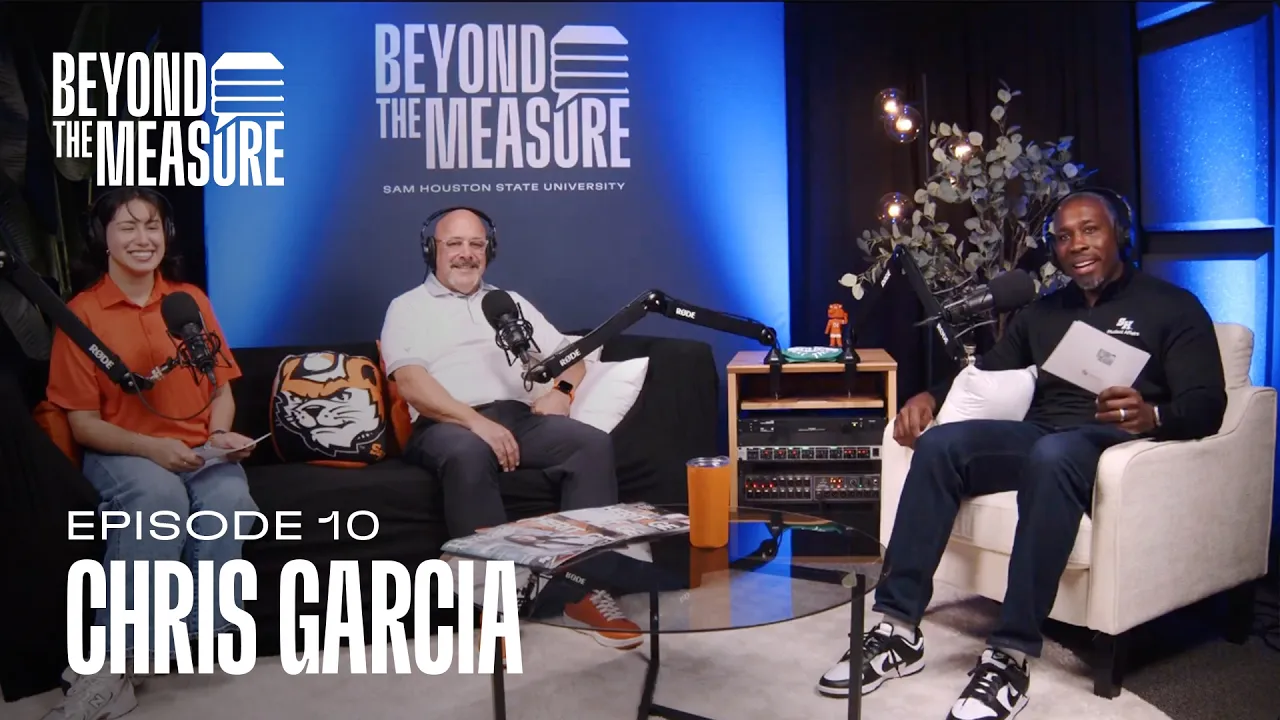
Beyond The Measure Episode 10: Chris Garcia
Beyond The Measure Episode 10: Chris Garcia
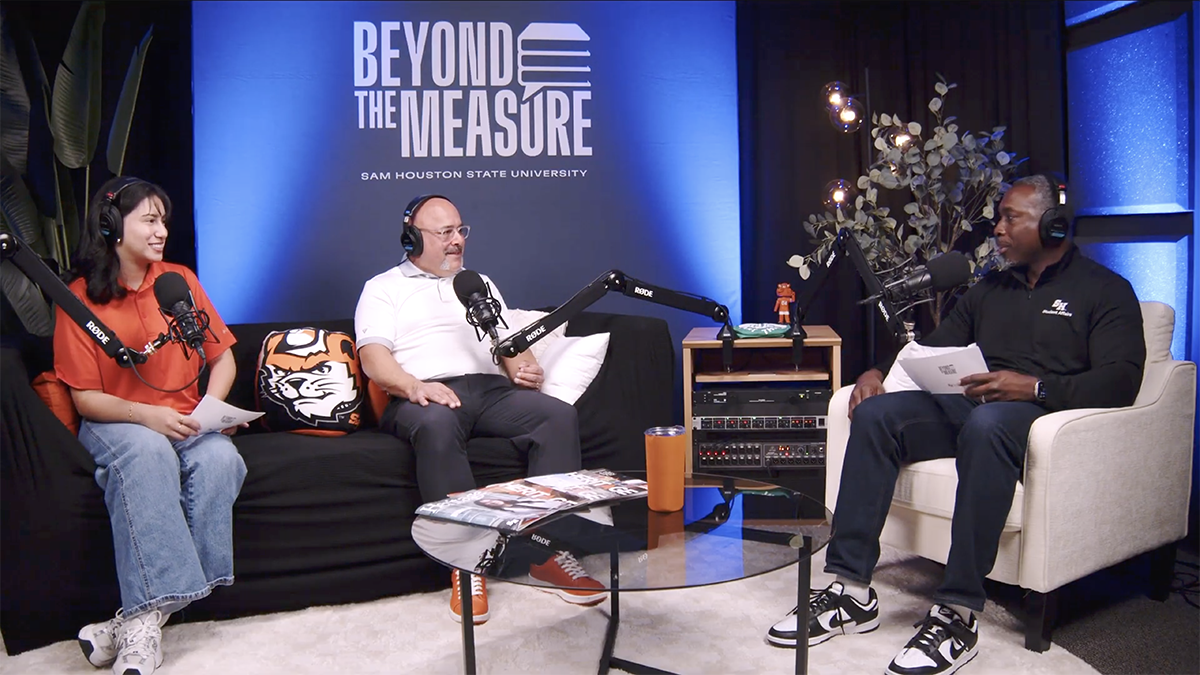
The October episode of Beyond the Measure showcases the Smith-Hutson Scholars program at Sam Houston State University. Chris Garcia, director of the program, shares how the scholars receive more than a scholarship; they gain a community ready to support their success. The following lays out the discussion in a convenient Q&A format. For the full Beyond the Measure experience, watch the full episode below or on YouTube.
For those that aren't familiar, can you start by explaining what the Smith-Hutson Scholar Program is and what role it plays here at Sam Houston State University?
The Smith-Hutson program is an amazing program that we started 30 years ago, as of March 1st. We're embarking upon our 30th anniversary as a program, our 30th year of being in a strong partnership with Sam Houston State. We're at five institutions, but this is our flagship school. It was the alma mater of both our donor, Mr. Smith, and our donor's representative, Mr. Hutson. And it has been a program that has put now 1,300-plus students through school from one generous donor.
When students join the program, what are they really stepping into beyond just receiving that scholarship?
When people think scholarship, the first thing that comes to mind is money and, certainly, we provide that, up to $20,000 per academic year per student. But what we do is more about lifting students up, building a community of students. We find every way we can to connect our students. We start that very early on, about a month after we select our students. So, we'll select in March, and in April, we'll have the students we selected come back on campus and do a campus preview with them. It starts this amazing meshing of personalities and many times they select their roommates on that day. This past year, we found that we had students who were doing sleepovers over the summer with their future roommates to get used to them. So those challenges that students report having when they come on campus - being lonely, homesick, disconnected and not feeling a sense of belonging - traditionally, our students aren't dealing with those because they've already got that built-in family and network.
So, how do you encourage students to see their educational journey as more than just personal success?
That’s one of the things that we talk about a lot from the beginning. I've only had one o other employer as an adult, I worked for the Marine Corps for 27 years, and the first thing I learned about leadership was the first day I stood at the Marine Corps recruit depot in San Diego. I learned that nothing is about me; it's always about taking care of the recruit to our left and right and to do that for to our fore and our aft. That was the most important thing I ever learned about leadership, and that's what we try to impart upon our students. You have this scholarship, so congratulations, but it's not about you. It's about taking care of others, lifting others up, and that's why we have such a robust leadership network within our program and across the Sam Houston campus at large, because our students learn to serve and that's what they enjoy doing on top of excelling academically.
What kind of experiences do you foster to push them to grow not just academically but as leaders?
We have a very robust leadership apparatus, and it starts with our rising sophomores. We ask them to apply to be what we call PAL mentors, or Peer Assistant and Leadership mentors. We have so many applications from people who just want to serve and develop that next group of freshmen next year, when they rise into their sophomore year. We also have four community-building houses, metaphorical houses similar to Hogwarts, where we've got four houses named after Sam Houston's actual houses. So, we've got Bearbend, Steamboat, Woodland and Raven House and we've got coaches that lead those houses and they compete against each other for grade point average. We have an annual retreat where they'll do 15-person canoe races and do community service projects, like can drives. Much of it is them lifting each other up as a group and working together toward common goals.
In what ways do the scholars contribute to the campus or the community while they're still students?
They enjoy serving others and we have students who have applied to Visitor Services to be the official ambassadors for the university as well as ambassadors for their colleges. I think we have three pr four students over there with the president's own group of ambassadors, the Orange Keys. She doesn't have too many of them, but a good percentage of Orange Keys are Smith-Hutson Scholars. All across this campus, Smith-Hutson scholars are serving other students and helping them succeed.
We're about to embark upon a huge initiative in March where we have found again that students on campus have been feeling disconnected, homesick and lonely and we believe a lot of that boils down to more phone usage than face-to-face communication. The initiative, “Together We Can Do Heart Things,” is going to involve our students intentionally reaching out, giving a cookie or a button to another student and starting a conversation. We really think that this is going to be very effective in connecting students across campus together and helping them feel more connected to the community.
You work closely with these students, so what changes do you see in them from freshman year up until graduation?
It's like the difference between night and day. Students show up not very confident, feeling disconnected, not understanding what they really want to get into. A lot of what we do is coaching, mentorship and de-escalating certain feelings with students who are feeling internal conflict. Part of that is helping them pull out what their passions are, and not necessarily what mom and dad told them they should do. I think the best satisfaction is to see when a student goes forward with their own fire that's burning inside of them to go do something and they pull away from what they were told they should do. You can see the freedom and the liberation of that choice and the grades improve almost overnight when that happens. It's great to see that growth. We see students go on to do amazing things, and they're always coming back asking how they can plug in plug back into the program and mentor other students. It's a fantastic thing to see from start to finish.
Is there a particular moment, project or interaction where you see that growth really take shape?
The Smith-Hutson Scholars program does second-step advising where students check in with an adviser at the SAM center, then follow up with us. We go over their degree plan and notes with them, make sure they understand what their adviser said and talk to them about the courses they are supposed to take. We also ask about their personal life and how everything's going. I had a student in 2021 who was the first one at every one of our events, the first one in class every single class period. She also helped tutor other students. Well, she didn't show up for her second step advising. I joke around with students, asking, “It's 1:20. What time does our 1:00 p.m. meeting start again?” And her mom texted me saying the student is in the hospital and my heart just dropped. She had leukemia. She had it before she came to school and did not put it on her essay, did not share any information about it, yet she was the first one in class, the first one at every event. She was in the hospital for 48 days, I think, during that semester and finished with a 3.45 GPA, doing her homework and classwork from the hospital bed. In that moment, she became my hero. Every single day when I get on campus, I thank the good Lord I get to do this because of students like her, who have shown me it's not about me.
So, what kind of impact does the Smith-Hutson Scholars have on the broader SHSU community?
It's unlimited. I think we just kind of scratched the surface with our campaign that we're about to have. I anticipate that being a very effective campaign to get people to start talking again, get out of their rooms more, get out of their beds, and not be as fearful to have face-to-face communication with one another. We think, of course, that's going to be good for the campus, but we also believe it's going to be good for our students because they're going to have these conversations and improve their communication skills as well. The students will just go out of their way to help other students. It doesn't have to be Smith-Hutson scholars, and many times it's not. Many of our students bring their classmates, their roommates or different people into our space and we talk to them, we have fun with them, we invite them to some of our events. So, I think there's just a very positive feeling around Smith-Hutson scholars. I think they're just good people, and it's just an honor to spend time with them and to serve them on a daily basis.
When students leave Sam Houston, what do you hope stays with them long after the program is over?
I think a sense of humility. It goes back to them giving back and knowing they love that they accomplished this, finishing with that degree. But they also think about who's out there that could hear their voice and be encouraged to overcome a hurdle or a challenge that's got them hitting a wall. Many of our alumni have done that. So many of our current students have done that, have had encouraging words for our students. One of my students gave me an essay the other day, just out of nowhere. I didn't ask for an essay, but I had an essay that talked about how she was lonely when she came to school. She didn't know what she was going to do. She was worried about not making friends and she realized very early on that she found her family through the Smith-Hutson Scholars. If you want to encapsulate what we're about, it's that.
What does it mean to you personally to lead a program that invites so many intentional students?
It is an honor. I feel immensely blessed. I think back to my own life and my own childhood and some of the things that I've had to go through, and I just think at some point you figure out what your purpose is. When you find out your purpose, you feel very free. I found my purpose and I feel very blessed to have the administration that we have here that supports our program. We have a foundation that's incredible, and they support our program. And to both of those entities, all three of us - myself, the administration and the foundation - focus on one thing, and that is serving our students to the best of our ability and we all love what we do.
For students that may be wondering if they're ready to apply, what would you tell them about stepping into this kind of opportunity?
I would say the first thing is: it's an amazing opportunity. I will also say that we're only open to currently front-facing students. So students who are not at Sam yet. But we are actually piloting a program for next year, and I hope it goes through, for an upperclassman scholarship. That would be for students who are on the Sam campus, as long as there's a way that they have demonstrated service to others and leadership. I would also say that Smith-Hutson Scholars are authentically themselves because that's what we're all about. So for those wanting to be part of something like the Smith-Hutson Scholars, just be who you are. Don't be who somebody else wants you to be. I think that's what makes our students very special.
Note: Following the filming of this episode, the "We Can Do Heart Things" campaign launched and has been helping students make connections on campus.
This page is maintained by SHSU's Communications Office:
-
Director of Content Communications: Emily Binetti
-
Communications Manager: Mikah Boyd