First Clinical Rotation Leads SHSU-COM Student Doctor to Life-Changing Patient Diagnosis
First Clinical Rotation Leads SHSU-COM Student Doctor to Life-Changing Diagnosis
Third-year student doctor Caroline Podvin, Class of 2027, entered her internal medicine rotation eager to learn how experienced physicians work through complex cases and uncertainty.
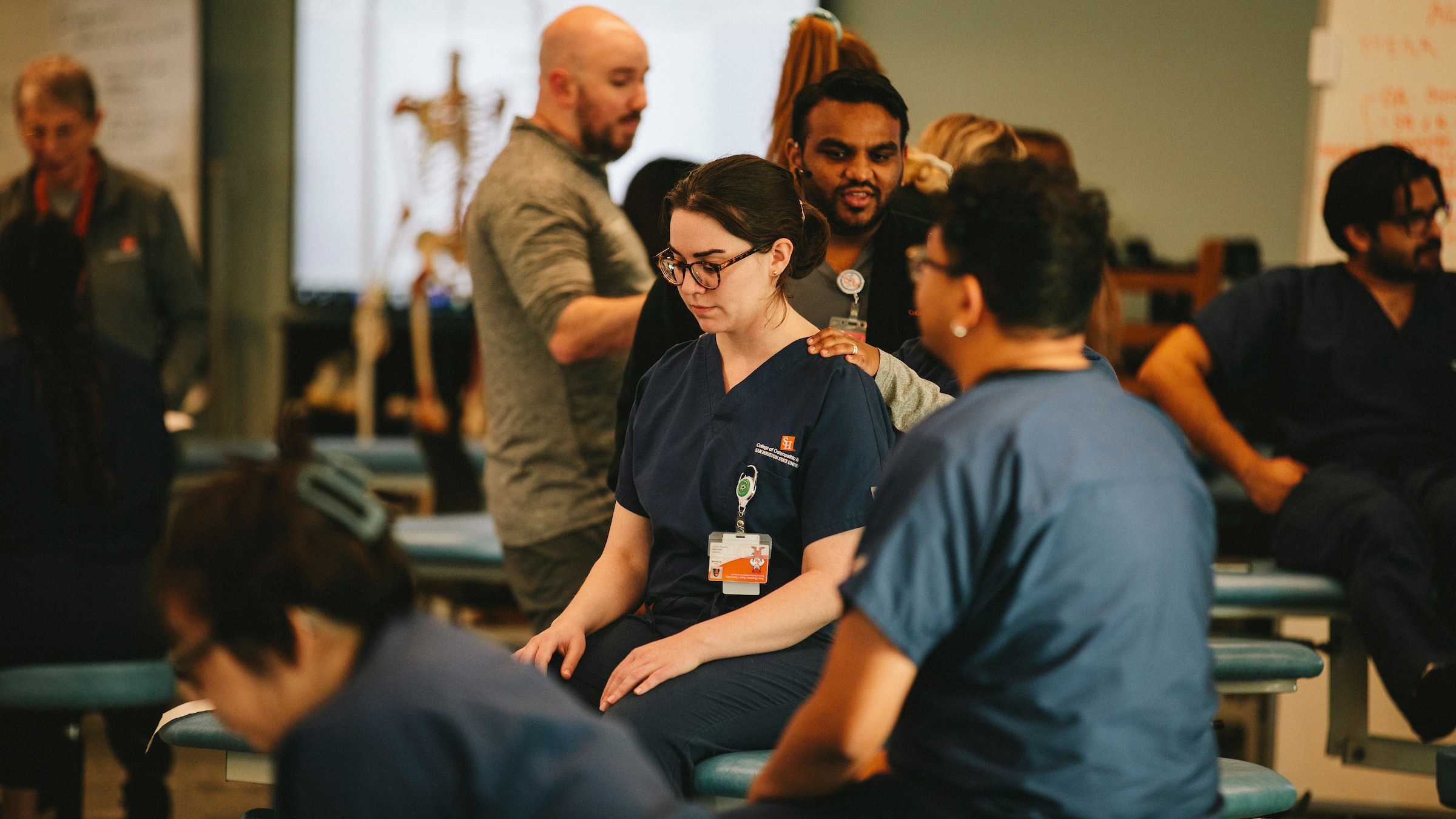
 At SHSU-COM, the first two years of medical education take place on campus in Conroe with classes, labs and clinical simulations. The third and fourth years move student doctors into clinics and hospitals across Texas, where they rotate with and learn from practicing physicians, known as preceptors, who serve as clinical faculty and guide students through real patient care settings.
“Internal medicine was my first rotation of third year and I was intimidated,” Podvin said. “There is a reputation of expert precision, attention to detail, complex reasoning and such a rich knowledge base.”
Despite the nerves that come with a first rotation, she approached the clinic feeling grounded in the examination and communication skills she developed during her preclinical years at SHSU-COM.
Early in the rotation, Podvin met a patient with symptoms that would be difficult for any clinician to connect because the underlying condition, later identified as Sneddon syndrome, is extremely rare and does not follow common diagnostic patterns. She listened closely to the patient and their family, completed her exam and began weighing what she observed against what she expected. The patient’s history included many pieces that seemed unrelated at first glance, and the puzzling nature of the case drew Podvin into a deeper conversation with her preceptor about possibilities that might tie the findings together.
“I recall first mentioning to my preceptor how this case seemed too atypical to not be a syndrome,” Podvin said. “After seeing the patient and writing my note, I decided to investigate potential syndromes or diseases consistent with their history and exam.”
Her preceptor encouraged her to follow her intuition. After researching conditions that could connect the patient’s symptoms, Podvin identified a rare syndrome that is challenging for any clinician to spot early. Additional testing supported her suspicion and helped the care team move toward a clearer diagnosis. The patient and their family later expressed gratitude for her persistence and careful attention.
“This case has impacted me significantly,” she said. “I still hold an incredible feeling of fulfillment and joy that this patient now has a clearer future ahead.”Podvin credits her training at SHSU-COM for helping her recognize when something does not fit the usual pattern. She shared that early simulations and hands-on training taught her to trust her instincts and research what might seem unclear.
“I feel that SHSU-COM trained me well to be mindful of that feeling or intuition that something is not quite right,” she said. “I was always encouraged to research what I did not know, and this felt like a natural process for addressing a puzzling case.”
She hopes future student doctors embrace the learning process, and the guidance preceptors provide.
“This is the time to make mistakes and ask as many questions as you can,” Podvin said. “People expect your best, but they do not expect perfection.”
Preceptors, she added, play an essential role in shaping future physicians. They model patient care, offer real-time guidance and help student doctors develop the confidence to think critically in real clinical settings. Across Texas, these physicians open their practices and welcome student doctors into the rhythm of real patient care. Their mentorship creates conditions where curiosity, careful listening and thoughtful assessment can take shape. Experiences like this show how much student doctors gain when clinicians invest in teaching.
For Podvin, this moment reaffirmed choosing medicine. For SHSU-COM, it highlights the powerful learning that happens when student doctors join experienced physicians in caring for real patients. And for the many preceptors who open their doors across Texas, it is a reminder that their mentorship can shape medical careers in ways that last far beyond a single rotation.